Friday, November 9, 2012

The Expensive, Diminishing Threat of Somali Piracy.


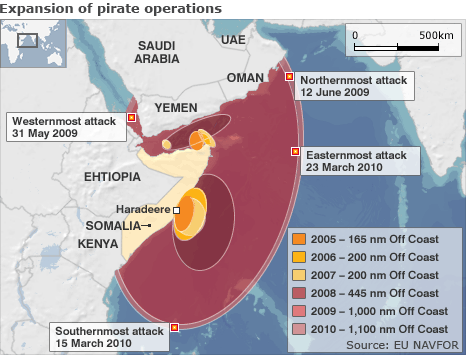
Piracy off the coast of Somalia has dropped off dramatically in 2012. Successful ship hijackings have decreased from 31 in 2011 (and 49 in 2010) to only four so far in 2012. Attacks against ships have also decreased, falling from 199 reported attacks in the first nine months of 2011 to 70 attacks over the same span in 2012 -- a 65 percent drop. However, diminished activity does not necessarily mean a decrease in the cost of sailing around the Horn of Africa. Somali pirates occupy a unique position, which is right along highly strategic global shipping lanes yet outside the reach of any national power. For international actors, it is politically and militarily easier to try to contain the Somali piracy threat than to eliminate it. But containment comes at a high cost.


Controlling Territory

Many factors have contributed to the decrease in pirate hijackings in 2012. One factor is that shipping companies have begun equipping their ships with more countermeasures, namely armed guards. For several years, commercial ships sailing in the Indian Ocean have used other countermeasures, such as fences, water cannons and adjusted tactics like disabling the ship. But the widespread deployment of armed guards beginning in 2011 (guards had been used sparingly as far back as 2008) has a very close correlation to the recent decrease in hijackings. In late 2009, only about 10-20 percent of commercial ships sailing through waters where Somali pirates operate carried guards; today, some estimates put the percentage as high as 70 percent. To date, pirates have never successfully hijacked a ship that had armed guards. But it should be noted that, even though the use of armed guards appears to be the most effective countermeasure against piracy, there are other factors at work.

For instance, government officials also attribute the drop-off in attacks and hijackings to better coordination between foreign naval patrols, which have made the waters off the Somali coast a less permissive environment for pirate operations. With several years of practice, sailors from international missions such as the U.S.-backed Combined Task Force 151 and the EU-backed Atalanta mission as well as from the unilateral missions of China, Russia, Iran and others have had time to study pirate activity and become more efficient at stopping attacks.

Several dozen foreign naval ships are deployed to secure the waters for commercial shipping at any given time. Their focus is escorting ships through the Gulf of Aden, but the area of pirate activity is much larger than that, reaching across the Arabian Sea to India and Madagascar. Effectively patrolling such a large area requires intelligence and the development of a counterpiracy doctrine that includes going after the larger pirate vessels, called mother ships, that extend pirates' range and allow them to operate in rougher seas during the monsoon.

Taken together, the increased use of armed guards aboard commercial ships and the growing effectiveness of foreign naval patrols have contributed to undermining the pirates' control over the seas. Three years ago pirates were largely uncontested, but now they face a more coordinated defense. They hijacked commercial ships because they were relatively soft targets -- which could be taken by four people with AK-47s, a fishing boat and a ladder -- making the millions of dollars in profit from a ransom payment very attractive. The armed guards and naval patrols have not eliminated piracy, but they have increased the costs of attacking and seizing a commercial ship.
Because pirates are motivated more by profit than by any ideology, a decrease in profitability will deter them from engaging in the practice.

Still, whatever the status of the sea, the coastal towns of Somalia, such as Hobyo and Haradheere, are still out of the control of any national or international force. The Puntland Maritime Police Force, which began operations in early 2012 with the help of Arab funding, made some progress in denying pirates sanctuary on land, but political contention prevents it from controlling the territory outright, making pirate activity still a very attractive economic model in central Somalia.

When piracy flared in the Strait of Malacca in the early 2000s, Singapore, Indonesia and Malaysia were able to pursue the pirates on land and deny them sanctuary because they had the security forces and territorial integrity to do so. This is also true currently on the western coast of Africa in the Gulf of Guinea, where pirates occasionally hijack ships even though they have no ports in which to anchor the vessels. Since the West African governments have control -- however tenuous -- over their own sovereign territory, they still have the means to track down hijacked ships and keep pirates from creating sanctuaries. Somalia, on the other hand, has struggled for decades to control its territory.
Over the past few years, it hasn't even been able to fully control Mogadishu, its capital, against the Islamist threat from al Shabaab. The new Somali federal government still lacks the capability to control pirate towns such as Hobyo and Haradheere, and its officials do not appear to want a strong Puntland doing it for them.

By wresting maritime control from Somali pirates, commercial shipping companies and foreign navies have reduced the number of attacks but have not eliminated the threat. Several Western forces, including those of France, the United Kingdom and the United States, have gone on land a few times to pursue pirates, but generally, foreign militaries have avoided Somalia. Whereas the countries bordering the Strait of Malacca or Gulf of Guinea are able to go on the offensive to root out piracy, the rest of the world, unable to rely on Somalia, is going on the defensive.

In essence, the commercial shippers and naval forces have adopted a siege strategy -- they hope to starve the pirates of resources, forcing them to give up. Somali pirates held about 20 ships at any given time in 2010; they currently hold 11. As the pirates hijack fewer ships, and as armed guards make piracy more dangerous, the entire enterprise is looking less lucrative and appealing.


The Bottom Line
Even though the Somali pirates have not been as successful in 2012 as they were in recent years, their existence is still making it more expensive to sail around the Horn of Africa. The problem with the siege strategy is that as soon as shipping companies or foreign naval forces let up on the pirates, they will go back to hijacking ships.

The cost of prevention right now is high. It is impossible to know exactly how many ships are vulnerable to Somali pirate attacks each year, but we know that about 33,000 commercial ships pass through the Gulf of Aden yearly. Estimates of how many of those ships carry armed guards range from 40 to 70 percent. That means that about 13,000-23,000 ships are paying for armed guards to accompany them through the vulnerable areas, a roughly 10-day trip, at a cost of approximately $60,000 each time. Based on those figures, the total annual cost for shipping companies merely to deploy armed guards on their ships through the Gulf of Aden is between about $800 million and $1.4 billion. The total cost of piracy to the world in 2011, according to the One Earth Future Foundation's estimates, was between $6.6 billion and $6.9 billion. This estimate included $160 million for ransom payments; other preventative measures, such as rerouting ships or using more fuel to maintain higher speeds, made up the rest of the costs.

In other words, the cost of preventing piracy off the coast of Somalia is substantially higher than the costs piracy inflicts. Nevertheless, shipping companies are willing to pay a premium to prevent disruptions in their operations. They would prefer to pay a small amount for protection on each trip -- even though it adds up -- if it means averting a hijacking and multimillion-dollar ransom.


Somalia's Future

The key component of the siege strategy is that it weakens the pirates' control over their land-based sanctuaries. Their power is connected to their revenue, so the decrease in revenue will decrease their power. The shipping companies and foreign navies hope that some other, less disruptive enterprises will eventually take root along Somalia's pirate-heavy coast.

In the midst of forming its first permanent government since 1991, Somalia is currently incapable of addressing its lack of control over the central Somali coast. Instead, it is focusing on securing the population bases of Mogadishu, Kismayo and other small towns in south-central Somalia from al Shabaab. This will occupy the government for at least the next year. Even after that, Mogadishu has little incentive to try to tighten its control over central coastal pirate towns. The government has much more to lose if it fails in southern Somalia because it redirected scarce government resources to take on piracy. The pirate-held areas are economically depressed and are politically less important. That's why they started engaging in piracy in the first place.

The only force that has significantly challenged the pirates on land is the Puntland Maritime Police Force. Located in northeast Somalia, Puntland is much more stable than the south and is virtually independent. The Puntland Maritime Police Force had success in capturing pirates, destroying their staging bases along the beach, cutting off their supply routes and even, supposedly, attempting to seize hijacked vessels from the pirates. However, the police force suffered from funding cuts and political opposition and appears to no longer be active against the pirates. Although Mogadishu is unable to control much of its territory, the new government doesn't want regional governments accumulating too much strength. In the end, a strong Puntland may be more of a risk to Mogadishu than pirates.

Without a sustained, land-based intervention, Somali piracy will continue -- even if it is at a lower rate -- at least until some other criminal enterprise takes its place. But even at its lower rate, as long as Somali pirates are operating, they will be an expensive burden for the world's shipping industry.


Font: "The Expensive, Diminishing Threat of Somali Piracy is republished with permission of Stratfor."


Tuesday, November 6, 2012

Election Day - USA 2012


This will be my only political post. But our Military is already hurting... 4 more years is going to crush it. I hope everybody sleeps peacefully knowing our Enemies are celebrating right now.
That is all.


Sunday, November 4, 2012

War Game: The Hours following an Attack on Iran’s Nuclear Infrastructures - The Policies of the Actors and Principal.


The Institute for National Security Studies (INSS) held a war game (simulation) focusing on the first 48 hours after an Israeli aerial attack on Iran’s nuclear infrastructures.


The Scenario
After midnight on November 9, al-Jazeera reports that Israeli airplanes have attacked Iran’s nuclear facilities in three waves of attack. As reports multiply, Israel officially announces it has attacked Iran’s nuclear sites because it had no other choice. According to the scenario, Israel did not coordinate the attack with the United States in advance, and only informed the US once the planes were already en route to the Iranian targets. Initial assessments estimate that the Iranian nuclear program has been set back by nearly three years.
Following the successful attack, Iran decides to react with maximal force, launching missiles from within its borders and urging its proxies – Hizbollah, Hamas, and other radical elements – to attack Israel. Nonetheless, it is careful to avoid attacking American targets. Israel attempts to contain the attacks and works to attain a state of calm as rapidly as possible. The international community is paralyzed, largely because Russia tries to exploit the situation for its own strategic objectives. At the end of the first 48 hours, Iran continues to attack Israel, as do their proxies, albeit to a lesser extent. At this point in the simulation, the crisis does not seem to be close to a resolution.
Main Policies of the Various Actors
 
 
Israel: After achieving its operational goals, Israel showed restraint in the face of provocations and reactions by the radical players spurred by Iran. In parallel, Israel conducted an additional aerial attack to complete destruction of one of the major targets in Iran. Israel’s strategic objective focused on preventing regional escalation and achieving as fast as possible a level of events that was controllable and of low intensity.
 
 
The United States: Although not informed before the event, the United States clearly stood by Israel’s side and did not expose its differences of opinion with Israel, in order to present a united front against any possible regional escalation. The United States demonstrated willingness to return to the negotiating table and even relax the sanctions, provided Iran showed restraint and in exchange for an Iranian declaration it was ending its military nuclear program. The United States decided it would take military action against Iran only if Iran were to close to the Strait of Hormuz or attack American allies and assets in the Gulf. Similarly, the United States activated economic measures to control the rise in oil prices.
 
 
Iran: In light of the outcome of the Israeli attack, Iran felt it had no choice but to react strongly and militarily against Israel, launching some 100 Shehab missiles right away (and another 100 in round two) at Tel Aviv, the Negev Nuclear Research Center in Dimona, and various cities. Iran also pressured its proxies to act against Israel and launch rocket and missiles at Israeli targets, as well as engage in multi-front acts of terrorism. At the same time, Iran appealed to the international community to grant legitimacy to its enrichment program and revoke the sanctions against it. At first, Iran chose not to attack American targets and assets to keep the United States from joining the fight against it. But the more Iran felt it was cornered and its freedom of action was curtailed, it realized that its strongest card lay in acting against America’s allies in the Gulf and closing the Strait of Hormuz.
 
 
Russia chose to promote its objectives in the Caucasus and Europe. Russia also viewed the attack as an opportunity to position itself as the leading actor in the international community because of its ability to communicate with all the actors involved. However, the gap between the US and the Russian positions led to a paralysis of the international community’s ability to act. In turn, and in the absence of American leadership, China, with access to all the relevant actors, became a key player on the international field.
 
 
Syria preferred to focus on its domestic upheaval, maintain a low profile, and not be dragged into combat against Israel.
Hizbollah found itself in a quandary. On the one hand, Hizbollah came under heavy Iranian pressure to begin a massive launch of missiles and rockets at Israel, this being the “day of reckoning” for which Iran had furnished Hizbollah with 50,000 missiles and rockets. On the other hand, Hizbollah was wary about causing heavy damage in Lebanon yet again. It therefore chose to respond to Iran’s demands selectively by launching rockets at Israeli military targets, especially airfields and active anti-missile defense systems. Israel’s restrained response intensified Hizbollah’s dilemma and supported its decision to attack to a relatively limited degree and focus on military targets.
 
 
Hamas chose to walk a fine line by demonstrating some commitment towards Iran, while making sure not to provide Israel with an excuse for a large scale attack in the Gaza Strip. Hamas’ limited ability to control rogue and radical elements in Gaza was evident, and Hamas was forced to ask the Muslim Brotherhood in Egypt for help in restraining the rogue elements it lacked the power to control.
 
 
The other actors – Egypt, Saudi Arabia, the Gulf states, Turkey, and the international community: Each chose to operate on the basis of its own particular interests, distance itself from the events, and prevent widespread regional escalation.


Insights from the War Game

a. The war game staged the first 48 hours after the attack. The intention was not to predict developments, rather to examine the significance and implications of one possible scenario. The players acted very rationally, demonstrating preventive policies and motivated by crucial interests alone, and ignored domestic and external constraints.
b. The Israeli actor assessed that the Israeli public possesses the stamina and fortitude to absorb the blows because it was convinced that for Israel, this was a war of no choice that had achieved is operational goals. The policy of restraint was based primarily on this assumption.
c. Iran has only limited tools and a limited ability to hit Israel directly, and therefore must operate its proxies against it. Iran has tools that are more relevant in the Persian Gulf sector, capable of hurting American interests and causing global oil prices to spike. Nonetheless, Iran clearly understood the cost it would have to pay should it ignite the Persian Gulf, especially the United States joining the fighting. This would only incur greater damage to its nuclear infrastructures and greater destruction to a wide array of quality targets in Iran.
d. A successful Israeli attack with clear cut results and the meeting of the operational objectives would lead to two contradictory trends: on the one hand, Iran would be obligated to respond militarily and via its proxies; on the other hand its dependence on proxies would allow deterrence of the relevant actors and insertion of a wedge between Iran and its regional allies, thereby preventing regional escalation and encouraging containment.
e. Two other important elements likely to help contain the events are America’s clear resolve to stand with Israel and a restrained policy on Israel’s part, especially if the strategic objectives of the attack were met in the initial attack.
f. The simulation again raised the disadvantage of having no access to Iran's Supreme Leader and the limited levers of influence. In general, it became clear that there are no reliable lines of communication with the Iranian leadership. While Russia cannot serve as a credible channel for dialogue, it emerged that China may be capable of serving as a mediator.
g. In planning the exit strategy and a mechanism to contain and mitigate negative developments, Israel cannot rely on the international community. It is highly probable that the deepening of the divide between the United States and Russia would paralyze the international community. Some of the players on the international arena would like to see Israel "bleed" in order to pay for attacking Iran, regardless of the interests of others, and to restrain its actions in the future. If the crisis were prolonged, it could generate unintended consequences with the risk of regional escalation. Efforts by regional and international elements to end the event may involve a cost to Israel in the area of arms control.


Conclusion


When the simulation was planned, it appeared that the fall of 2012 would be a critical period, and therefore it was decided to examine the possible developments subsequent to an Israeli attack. This sense of an imminent decision has since abated somewhat, but after the US and Israeli elections, the question of an attack will undoubtedly resurface. It is therefore critical to continue to examine the potential ramifications of an attack.
The scenario of an Israeli attack immediately after the US elections does not reflect the position of the Institute for National Security Studies. The possibility of an Israeli attack at any time is complex and has been analyzed in many INSS publications. Overall, there are two opposing assessments of the implications of an Israeli attack. One anticipates the outbreak of World War III, while the other envisions containment and restraint, and presumes that in practice, Iran’s capabilities to ignite the Middle East are limited. The war game that took place developed in the direction of containment and restraint, with the actors motivated mainly by rational considerations and critical interests.
 
 
Font: המכון למחקרי ביטחון לאומ

Friday, November 2, 2012

Guns and Butter in Billion-dollar Arms Deal

«Chi ha orecchie per intendere intenda.»
«He that hath ears to hear, let him hear.»


http://indiatoday.intoday.in/story/billion-dollar-arms-deal-in-army-gun-manufacturers/1/221665.html


Russia Foresees Maintaining Land-Based ICBMs Over Long-Term

The Russian military predicts a long future for the land-based component of its strategic nuclear triad, RIA Novosti (1) reported on Thursday.

Russian nuclear-tipped ballistic missiles can presently be fired from movable platforms or from stationary silos. The mobile launchers are envisioned for use in a second retaliatory strike while the silo-based missiles are held to prevent possible attacks.

"This [strategic missile forces] structure will most likely remain unchanged for years or even decades to come," SMF Deputy Commander Lt. Gen. Valery Mazurov told the Rossiya 24 channel. "The composition of ICBM systems (2) (in SMF structure) is based on a thorough analysis of potential military conflicts of varied intensity that involve the use of nuclear weapons."

The strategic missile forces are understood to presently have a minimum of 160 movable Topol ICBMs, 18 road-transportable Topol-M missiles, 50 Topol-M missiles in silos, 58 SS-18 high-altitude missiles in silos, and 18 RS-24 Yars ballistic missiles.

In 2011, the strategic missile forces announced the RS-24 and the Topol-M would form the backbone of the land-based leg of the nation's nuclear deterrent and would form a minimum of four-fifths of the SMF stockpile no later than 2016.

The strategic missile forces are wrapping up protective updates to nine key missile sites that are intended to thwart possible extremist assaults, RIA Novosti (3) reported.

"The modernization includes the upgrade of warning and surveillance systems, detection sensors, integrated fire control systems and power supply grids," SMF spokesman Col. Vadim Koval said.

"The overhaul is being carried out at the highest levels of secrecy in regard to the specifications of the installed equipment and its operating algorithms," he said.

The organization is also updating its training and operation regulations for guards protecting stationary and movable missiles.


(1)Russia to Keep Silo and Mobile ICBM Launchers in Future.

Topol-M systems
MOSCOW, November 1 (RIA Novosti) – Russia’s Strategic Missile Forces (SMF) will continue deploying silo-based and mobile ballistic missile launchers in the future, SMF Deputy Commander Lt. Gen. Valery Mazurov said on Thursday.

The two-component structure of the SMF reflects its purpose as part of Russia’s nuclear triad. Silo-based ICBMs serve as a preventive nuclear deterrent of any potential aggression while road-mobile ICBM launchers ensure the capability to respond to nuclear strikes by potential foes.

“This SMF structure will most likely remain unchanged for years or even decades to come,” Mazurov said in an interview with Rossiya 24 television.

“The composition of ICBM systems [in SMF structure] is based on a thorough analysis of potential military conflicts of varied intensity that involve the use of nuclear weapons,” the general said.


According to open sources, the SMF currently operates at least 58 silo-based SS-18 Satan ballistic missiles, 160 road-mobile Topol (SS-25 Sickle) missile systems, 50 silo-based and 18 road-mobile Topol-M (SS-27 Sickle B) systems, and 18 RS-24 Yars systems.

The SMF said last year that the Topol-M and RS-24 ballistic missiles would be the mainstay of the ground-based component of Russia's nuclear triad and would account for no less than 80 percent of the SMF's arsenal by 2016.


(2) Moscow Finishes Arming Sector of Missile Force


A Russian RS-24 ICBM lifts off in a 2007 test launch.
A missile formation in central Russia is now fully
armed with Topol-M missiles and RS-24 launch systems,
Moscow said on Thursday (AP Photo).

Russia on Thursday said it had finished equipping its Teikovo missile formation, based in the nation's central region, with Topol-M and Yars strategic missile units, RIA Novosti (A) reported.

“The Teikovo division has become the first [strategic missile forces] division fully rearmed with fifth-generation mobile missile systems,” Russian Defense Ministry spokesman Col. Vadim Koval stated.

Moscow furnished Topol-M equipment to a pair of Teikovo formation regiments and Yars gear to the remaining two regiments. The Yars system is built to fire RS-24 ICBMs.

Meanwhile, Moscow on Friday indicated it cannot finalize the timing of a planned Bulava ballistic missile test launch due to difficulties involving computer code for managing the weapon's flight, ITAR-Tass reported.

Efforts are under way to address the faults, and officials hope to conduct the exercise before 2013 from the Borei-class submarine Alexander Nevsky, Russian Defense Minister Anatoly Serdyukov said.

A Russian defense industry insider previously said a new Bulava missile trial firing was slated to occur (B) from the vessel in November.


(3)Russia Boosts Security at Missile Launch Sites

Russia Boosts Security at Missile Launch Sites
The Russian Strategic Missile Forces (SMF) are finalizing the modernization of automated security systems at nine of its major missile bases to counter the growing threat of potential terrorist attacks, an SMF spokesman said on Wednesday.

“The modernization includes the upgrade of warning and surveillance systems, detection sensors, integrated fire control systems and power supply grids,” Col. Vadim Koval said.

The spokesman said that automated security at SMF bases is provided by six different systems, developed and produced by Russian defense industry firms.

“The overhaul is being carried out at the highest levels of secrecy in regard to the specifications of the installed equipment and its operating algorithms,” Koval said.

In addition to the modernization of the existing automated systems, the SMF is tightening rules of engagement and training requirements for security personnel at the bases and around mobile missile launch sites.

According to open sources, the SMF currently operates at least 58 silo-based SS-18 Satan ballistic missiles, 160 road-mobile Topol (SS-25 Sickle) missile systems, 50 silo-based and 18 road-mobile Topol-M (SS-27 Sickle B) systems, and 18 RS-24 Yars systems.


(A) Teikovo Division Gets Full Arsenal of New Missile Systems


Topol-M ballistic missile system

The Teikovo missile division of the Russian Strategic Missile Forces (SMF), based in central Russia, has been fully equipped with advanced Topol-M and Yars ballistic missile systems, the defense ministry said on Thursday.

“The Teikovo division has become the first SMF division fully rearmed with fifth-generation mobile missile systems,” the ministry spokesman Col. Vadim Koval said.

Two regiments of the Teikovo division are equipped with Topol-M systems while the other two regiments of the division are equipped with Yars systems.

The Yars missile system is armed with the multiple-warhead RS-24 intercontinental ballistic missile that has considerably better combat and operational capabilities than the Topol-M (SS-27 Stalin).
Two more missile divisions have started receiving the Yars systems in 2012, Koval said.

The Novosibirsk division (in Siberia) will receive mobile Yars systems, while the Kozelsk division (in central Russia) will be armed with the silo-based version of the system.

The SMF said last year that the Topol-M and RS-24 ballistic missiles would be the mainstay of the ground-based component of Russia's nuclear triad and would account for no less than 80% of the SMF's arsenal by 2016.


(B) Borei-Class Sub to Join Russian Active Force

The Russian Defense Ministry is set in September to assume control of the Borei-class ballistic missile submarine Yuri Dolgoruky, RIA Novosti quoted a United Shipbuilding insider as saying on Friday (see GSN, Aug. 15).

The vessel was previously slated to join the nation's active force in July and later in August, according to prior Russian navy statements.

The United Shipbuilding source added that a new Bulava ballistic missile trial firing is slated to occur in November from the Borei-class submarine Alexander Nevsky during the ship's testing.

Russia is expected to construct eight Borei-class submarines as successors to its older Project 667 boats, according to RIA Novosti. The new vessels, once equipped with the Bulava ballistic missile, are slated to constitute the backbone of Russia's submarine-based strategic ballistic missile deterrent.

Russia's military could take custody in 2012 of the Yasen-class atomic submarine Severodvinsk, the head of Russia's navy said separately. The vessel's atomic energy system faced technical issues that threatened to prevent the step until 2013, according to previous reporting.

Vice Adm. Viktor Chirkov stated: “Yasen is undergoing tests in accordance with the program. We hope it will raise the flag this year”.

No Russian atomic submarine has evaded detection in the Gulf of Mexico for a period of weeks, the U.S. Defense Department said on Thursday in response to a recent press report.

“I don't know what that information was based on, but it was not correct,” spokeswoman Wendy Snyder said in an RIA Novosti report.

A Russian Defense Ministry official declined to address the report


Font: NTI


Most U.S. Drones Openly Broadcast Secret Video Feeds

A MQ-9 Reaper drone on the runway in Ft. Drum, New York. Photo: USAF

Four years after discovering that militants were tapping into drone video feeds, the U.S. military still hasn’t secured the transmissions of more than half of its fleet of Predator and Reaper drones, Danger Room has learned. The majority of the aircraft still broadcast their classified video streams “in the clear” — without encryption. With a minimal amount of equipment and know-how, militants can see what America’s drones see.

Unmanned aerial vehicles, or UAVs, have become the single most important weapon in America’s far-flung pursuit of violent extremists. Hundreds of American Predators and Reapers fly above Libya, Yemen, Somalia, Pakistan, and Afghanistan — watching suspected enemies, and striking them when necessary. Nearly 3,000 people have been killed in the decade-long drone campaign.

“If somebody could obtain reliable access to real-time Predator or Reaper video — without attribution or alerting U.S. military — that would a tremendous intel coup,” says Micah Zenko, a fellow at the Council on Foreign Relations. “There is an insatiable demand from Predator and Reaper imagery in Afghanistan and elsewhere. Any reluctance to use those for spying or missile strikes places operations in Afghanistan, Pakistan, Yemen, and Somalia at some risk.”

Military officials have known about — and mostly shrugged off — the vulnerability since the development of the Predator in the 1990s. But the problem drew increased attention in 2008, when drone video footage was found on the laptops of Shi’ite militants in Iraq, who were able to intercept the feed using a piece of $26 software. The Pentagon and the defense industry assured the public that they’d close the hole by retrofitting the robotic aircraft with new communications protocols and encrypted transceivers that would keep the video from being intercepted again.

Four years into the effort, however, only “30 to 50 percent” of America’s Predators and Reapers are using fully encrypted transmissions, a source familiar with the retrofitting effort tells Danger Room. The total fleet won’t see its communications secured until 2014. This source and others who work closely with drone operations say that drones flying overseas are among the first to get the newly secured equipment. They also noted that they are unaware of any incidents of militants using America’s unmanned eyes in the sky to their advantage. “But I’m surprised I haven’t,” the source adds. “And that doesn’t mean it’s not happening.”


An instructor trains a pilot and sensor operator in the ground-based “cockpit” for a MQ-9 Reaper drone. Photo: USAF

This isn’t the only vulnerability in the drone fleet. In March of 2011, an unknown software glitch caused a Predator stationed at a U.S. base in Africa to start its engine without human direction. Last October, as Danger Room first reported, Air Force technicians discovered a virus infecting the drones’ remote cockpits in Las Vegas. It took weeks of sustained effort to clean up the machines. The aircraft, which rely on GPS to guide them through the air, can run into problems if GPS signals are jammed in a particular area — something that can be done with cheap, commercially available hardware. Iranian officials claimed they hacked the GPS control signal of an advanced drone, though it’s impossible to verify that lofty claim.

No one who works with UAVs is questioning the fundamental integrity of the drone fleet at the moment; it would take an incredibly sophisticated hacker to commandeer a Predator, for example. Nor is anyone pretending that this premiere tool of the U.S.global counterterror campaign is flawless.

Predators and the larger, better-armed Reapers transmit video and accept instructions in one of two ways. The first is via satellite, to remote pilots and sensor operators who are often on the other side of the planet; these satellite communications are encrypted, and are generally considered secure.

The second is through a radio frequency signal called the Common Data Link, which is used to share the drone’s video feed with troops on the ground. The CDL’s carrier signal — its specific pattern of frequencies, in a given order and for a given length of time — tells both transmitter and receiver on how to function. The problem is that the Predators’ version of the CDL carrier signal (also known as a “waveform”) didn’t include an order to encrypt the signal. So neither the transmitter on the drone nor the receivers that troops used on the ground employed encryption, either.

There were reasons for this. The original Predator, just 27 feet long, was little more than a scaled-up model plane with an 85-horsepower engine. It had a payload of just half a ton for all its fuel, cameras and radios. And encryption systems can be heavy. (Big crypto boxes are a major reason the Army’s futuristic universal radio ended up being too bulky for combat, for example.) With the early Predator models, the Air Force made the conscious decision to leave off the crypto.

The flying branch was well aware of the risk. “Depending on the theater of operation and hostile electronic combat systems present, the threat to the UAVs could range from negligible with only a potential of signal intercept for detection purpose, to an active jamming effort made against an operating, unencrypted UAV,” the Air Force reported in 1996. ”The link characteristics of the baseline Predator system could be vulnerable to corruption of down links data or hostile data insertions.”

The Predator models steadily grew in power and payload, and took a big leap in dimensions and capability with the 36-foot-long Reaper version introduced in 2007. The Reaper has a 950-horsepower engine and a nearly 4,000-pound payload — more than enough capacity for crypto-enabled systems which, like all electronics, had shrunk in size and weight.

The problem was that, by then, the military had rushed to the battlefield hundreds of Remotely Operated Video Enhanced Receivers, or Rovers – rugged, laptop-sized receivers with screens for watching drone footage. And those early version of the Rovers were developed and distributed so fast, the military once again left the crypto off. “It could be both intercepted (e.g., hacked into) and jammed,” e-mails an Air Force officer with knowledge of the program.

Which mean the Pentagon was stuck, for a time. The military couldn’t replace the old CDL waveform with something encryptable until the Rovers — and the radio transmitters aboard the Predators — could handle such a signal.

Eventually, the Rovers began to be swapped out for newer models. The latest version, the “Tactical Rover,” (.pdf) is about the size of an old-school mobile phone. It can use both the Advanced Encryption Standard an the triple-Data Encryption Standard to secure video feeds. There are now about a thousand of the units in the military’s hands.

And now, the Predators and Reapers are starting to get enhanced radios, too. “The fleet-wide upgrade begins later this year and carries on for several years,” says Maj. Mary Danner-Jones, an Air Force spokesperson. The service is spending $12 million on crypto-enabled Vortex transceivers (.pdf).

That’s allowing a new, hardened waveform to be introduced throughout the Predator and Reaper fleet. The Air Force recently gave Predator-maker General Atomics Aeronautical Systems a $26 million contract to retrofit its drone cockpits to accept the carrier signal, among other enhancements.

The question is why hasn’t this happened sooner. After all, the Navy installed multiple layers of encryption in their ’bots some time ago. Navy spokesman Jamie Cosgrove tells Danger Room that “the vast majority” of naval drones are encrypted – “and have been since development.”

One source who works on developing Navy UAVs, but is not authorized the speak on the record, explains why: ”Standard unencrypted video is basically a broadcast to whoever can figure out the right carrier frequency, so essentially, we are simulcasting to battlefield commanders and the opposing force. If that opposing force knows we can see them and from where, they can take better evasive maneuvers.”

It’s possible that none of the militants America is trying today are as sophisticated as the ones who intercepted that drone video in 2008. It’s possible that the value of such footage-from-above is so fleeting that extremists have never again bothered to grab it. But it’s worth noting that Predator and Reaper video is considered by the U.S. military to be classified information. And when U.S. commanders on the ground get into a firefight, the first call they usually make is for a drone, so they can take a look at the battlefield through the eyes of a drone.


Font: By Noah Shachtman and David Axe


The Empire Strikes Back?


The upheavals in the Arab world have created a situation that abounds with challenges for Russia, which has found itself sidelined in the Middle East by the Sunni coalition, working – in Russia’s eyes – in concert with the West.

From Russia’s point of view, the Middle East has now become a battleground for regional and global powers in their struggle over the future order. This confrontation has grown particularly acute because of the civil war in Syria between the Western-oriented Sunni camp and the Shiite camp, backed by Russia and China. Indeed, in this renewed conflict between global powers, Russia went from being a secondary player that cooperated with the West in the revolutions in North Africa to a dominant actor.
In the Syrian conflict, where it is waging a stubborn battle to defend its regional status, Russia has had some success thanks to a tactic that includes assistance to Syria. At work is an effort to isolate the battlefield (through extensive use of Russia's veto power in the UN and pressure to undermine any intentions of military intervention in Syria) and military and economic assistance to the Syrian regime, which consequently is managing to retain its relative advantage on the ground. While Russia has so far played the Syrian chapter well, it is also acting to ensure its future status in Syria, with attempts at dialogue with the Syrian opposition and preparation for the dissolution of the state. In this context, the Russians are reaching out to the various ethnic, religious, and other factions and groups in Syria and abroad.
Recently the confrontation has broadened, with Turkey increasing its intervention in the crisis, both vis-à-vis Syria and by directly challenging Russia. Turkish-Russian tensions, which surfaces in contexts other than the Middle East (such as in the Caucasus), is liable to escalate into a direct confrontation. At present, the friction between them also entails competition for influence vis-à-vis the Kurds throughout the region.
Russian-Western tensions are not limited to the Middle East. Russia feels Western pressure in regions important to it along its borders in the states of the former Soviet Union. Turkey seeks to expand the influence of NATO and sideline Russia in the Caucasus, adding fuel to the fire of Russian-Western tensions. Apparently Russia is motivated to cling to its stubborn stance in Syria at least in part by its desire to distance the United States from Russian areas of interest along its borders and confine it to the Middle East.
Recent changes in Russia’s conduct in the Middle East are evident. Moscow is becoming more assertive, moving beyond the Syrian conflict and the radical axis, and spreading to other areas. This is the conclusion from a review of several areas:
- Iran: Russian-Iranian cooperation continues against the background of the developments in Syria. This was reflected recently in renewed expressions of Russian support for Iran, countering the West's campaign against Iran’s nuclear program.
- Iraq: Along with Russian efforts to regain a serious presence in the country, Prime Minister al-Maliki recently visited Russia. During his visit various agreements were signed, including a $4.2 billion arms deals and oil production contracts. Iraq, in tense relations with its Persian Gulf neighbors on the one side and Turkey on the other, is thus repositioning itself in the region in clear defiance of the United States.
- Egypt is Russia's next objective. Recently Russia has spared no effort to interest the current Egyptian regime in restoring cooperation, damaged during the "Arab Spring," to its former state. Russian Foreign Minister Lavrov is scheduled to visit Cairo soon, and Egypt will likely respond favorably to Russia’s overtures.
- Saudi Arabia and the Gulf states: These nations, which since the "Arab Spring" have been battling the Shiite axis and trying to keep Russia out of the region, have ironically enough found themselves courted by Russia as it attempts to interest them in cooperation with tempting offers of military equipment. Foreign Minister Lavrov is expected to visit Saudi Arabia and other states on his way from Egypt, and some suggest that he will bring with him proposals to defend the Gulf states against the radical elements.
- Jordan too is within Russia’s sphere of interest, also apparently as a way to promote Russian influence over Jordan's domestic affairs. The full picture is not yet clear, but one may discern Russian designs in this direction.
- The Palestinians: Russia was and remains supremely interested in reviving the political process in the Israeli-Palestinian channel as a convenient platform for Russia to return to international affairs in the region and divert attention away from other centers of tension in which it is involved. Its support of Hamas has never diminished, even as it has continued to maintain a dialogue with the Palestinian Authority, hoping to create an opportunity to appear as a mediator between the two.
- Israel: There was a recent important breakthrough in bilateral relations, concerning joint ventures with strategic significance for Russia. This cooperation helps Russia extricate itself from its regional isolation and the negative ramifications of the "Arab Spring."
- Africa too, is in Russia’s new sphere of interest. The Russian President’s special envoy to the region, Mikhail Margelov, recently visited several states in eastern and central Africa in an effort to promote ideas for joint political and economic ventures.
An examination of the gamut of Russian activities in the Middle East raises the question of their common denominator. These activities are likely part of a clearly designed program, which on the face of it seems to be a diplomatic counter-offensive intended to extricate Russia from its isolation in the Middle East and restore its former status and recover former assets harmed by the "Arab Spring" and the regional Sunni-Western alliance. If so, we are looking at a Russian framework for overcoming its marginal status by promoting direct arrangements with regional states, wooing them with tempting offers, and waiting to reap at least some success, and perhaps even reestablish a bloc of supportive nations.
At the same time, it is also possible that we are looking at a much more complex and daring program, whose objective is to jumpstart a more far-reaching process. Perhaps at work is the start of a Russian program intended as a coordinated and concerted effort to establish a new regional order. In that case, the Russian framework includes moves that cover the entire region and are intended to change the current geopolitical reality in Syria, Iraq, and the Kurdish regions and beyond. There is significant, cumulative evidence supporting this possibility.
As usual in such situations, it is too early to assess fully what may ensue from a Russian program of this sort. In any case, it is evident that Russia is engaged in a comprehensive counter-offensive, conducted in all likelihood according to a clearly defined framework, which could have the power to affect the future shape of the region. Should this occur, even only in part, there is much food for thought for Israel regarding the implications of the new international reality taking shape around it, as well as more than a few issues that must be worked out with Russia.


Font: המכון למחקרי ביטחון לאומ


The Real 'El Chapo'.

A widely propagated myth would have us believe that Mexican drug lord Joaquin "El Chapo" Guzman Loera and his Sinaloa Federation are less violent than many of their competitors. Statements from journalists and analysts allege that Sinaloa is more businesslike than Los Zetas, whose reputation for brutality is well-documented, and that this business savvy somehow renders the group relatively benign. In turn, this has led many to believe that the Mexican government could broker a deal with the leader of one of Mexico's largest criminal organizations.

However, a close examination of Sinaloa's evolution demonstrates the group is hardly the hallmark of civility. In fact, the history of Mexico's cartel wars over the past decade reveals that Guzman, his Sinaloa Federation and the various cartels with which they partner have been more territorially aggressive than any other Mexican cartel.

Expansion and Escalation

Sinaloa incursions upset the balance of power that Miguel Angel "El Padrino" Felix Gallardo established in the late 1980s when he appropriated criminal territories to Guzman and his other lieutenants. Tens of thousands of people have died from the wars that arose from this imbalance.

This is because Guzman's expansion efforts necessarily entailed encroaching on a rival's turf. In the early 1990s, he sent forces from Sinaloa state into Tijuana, Baja California state -- controlled at the time by the Arellano Felix brothers -- to buy stash houses and construct a tunnel for moving drugs across the border. In response, the brothers tortured and killed Sinaloa operatives in Tijuana; they even tried to assassinate Guzman. Sinaloa retaliated in November 1992, when its operatives tried to kill Francisco Javier and Ramon Arellano Felix in a Puerto Vallarta nightclub.

The Sinaloa-Arellano Felix brothers war marked the beginning of an escalation in Mexico's cartel war. Cartels began to hire police officers to work as enforcers. Eventually, the Gulf cartel formed Los Zetas, a group largely composed of former soldiers from Mexican Airmobile Special Forces. Cartel warfare thus was militarized. Enforcer groups were no longer untrained thugs with guns; they were trained fire teams that knew how to maneuver and use their weapons.

Seeking shelter from the Arellano Felix brothers, Guzman fled to Guatemala but was arrested in June of 1993. He was extradited to Mexico, where he continued to run his criminal enterprises from the safety of a prison cell until he escaped in January 2001.


When Gulf cartel leader Osiel Cardenas Guillen was arrested in March 2003, Guzman saw an opportunity to make a move on the Gulf cartel's territory, especially the lucrative plaza of Nuevo Laredo, the busiest point of entry for trucks into the United States from Mexico that provides direct access to the Interstate Highway 35 corridor.

Guzman's push into Nuevo Laredo was spearheaded by the Beltran Leyva brothers, who convinced local gangs such as Los Chachos to turn against the Gulf cartel. Beltran Leyva gunmen aided local forces, and eventually a hybrid group was formed when a U.S. citizen and member of Los Chachos named Edgar "La Barbie" Valdez Villarreal assumed command of Sinaloa enforcer group Los Negros.

Los Zetas responded strongly to the Sinaloa incursion into Nuevo Laredo and a bloody struggle erupted for control of the city. By mid-2005, law and order had almost completely broken down in Nuevo Laredo, and then-President Vicente Fox deployed federal police and army units to take control of the town. But even these forces proved insufficient to stop the violence, which persisted for three years until it became evident that Los Zetas were not going to be defeated. By that time, Guzman had begun focusing on other places to expand.


A Boss of Many Groups
On Sept. 11, 2004, Sinaloa hit men gunned down Rodolfo Carrillo Fuentes, a leader of the Vicente Carrillo Fuentes organization, also known as the Juarez cartel, as he left a theater in Culiacan, Sinaloa state. Rodolfo's brother Vicente retaliated by having Guzman's brother murdered in prison. This chain of events set off a war between the two organizations for control of the Juarez and Chihuahua City plazas that continues to this day. (While the Juarez cartel is just a shadow of its former self -- Sinaloa has all but consolidated control of Chihuahua state -- Chihuahua nonetheless remains the second-deadliest state in Mexico because of this struggle.)

Sinaloa meanwhile had resumed its efforts to control Tijuana. A string of arrests and the deaths of the Arellano Felix brothers, who constituted the core leadership of the Arellano Felix Organization, severely degraded the group's operational capability. In early 2008, internal fighting between the faction loyal to the Arellano Felix brothers' successor, Luis Fernando "El Ingeniero" Sanchez Arellano, and those loyal to the group's top enforcer, Teodoro "El Teo" Garcia Simental, further degraded the organization. This conflict sparked marked levels of violence in the region until Mexican federal police dismantled the Garcia faction.
  
Desperate for support against Sanchez Arellano, Garcia sought protection from the Sinaloa Federation, which he knew had been trying to claim Tijuana for years. Ultimately the strategy failed, but the protracted battle left the Sanchez Arellano faction of the AFO extremely weak. In the latter half of 2010, the Sinaloa Federation used the opening afforded by Garcia to solidify control over parts of western Baja California state, namely the Tecate and Mexicali regions, positioning itself to seize Tijuana.


Knowing it could not withstand another lengthy battle against a much larger and resourceful group, the AFO struck a deal with Sinaloa whereby both groups would operate independently and abide by a non-aggression pact. With Tijuana secured, Sinaloa controlled the plazas from Juarez west to Tijuana.

In a similar scenario, the Gulf cartel turned to Sinaloa and La Familia Michoacana for help against Los Zetas, which had broken off from its parent group in early 2010. The three groups formed an alliance that referred to itself as the New Federation. Guzman's attention once again was drawn to the lucrative smuggling corridors in the northeast. With help from Sinaloa and La Familia Michoacana gunmen, the Gulf cartel was able to push Los Zetas out of Reynosa, and by mid-2010, Los Zetas were under heavy pressure from the forces of the New Federation. However, several events that year, including the July 29 death of Guzman's close ally, Ignacio "El Nacho" Coronel, and the Dec. 10 death of La Familia Michoacana leader Nazario "El Mas Loco" Moreno Gonzalez, gave Los Zetas an opportunity to recover.

In 2011, Sinaloa undertook another major incursion into Los Zetas territory, this time targeting Veracruz. In doing so, it used another proxy group as muscle -- the Cartel de Jalisco Nueva Generacion, comprising the remnants of Coronel's organization that traveled across Mexico from their home turf in Guadalajara. Sometimes operating under the moniker Los Matazetas, the CJNG began killing Los Zetas -- and people it believed to be Los Zetas supporters -- in Veracruz. In late September and early October of 2011, the CJNG conducted several high-profile body dumps of individuals deemed Los Zetas. In one incident on Sept. 20, 2011, 35 bodies were dumped on a street in heavy traffic. It was later determined that most of these victims were not members of Los Zetas.


As the CJNG shows, the Sinaloa cartel has formed several enforcer groups over the past decade. These groups have included Los Negros, the CJNG, La Gente Nueva (also known as Los Chapos) and Los Antrax. Such organizations operate under their own names, just as Los Zetas did when they were the armed wing of the Gulf cartel. But like Los Zetas, who acted on behalf on the Gulf cartel, Sinaloa enforcers act at the behest of Guzman and his lieutenants.

Instances of Sinaloa brutality abound. Los Negros leader Valdez tortured and executed four Los Zetas members in a video sent to the Dallas Morning News; the CJNG dumped 35 bodies in downtown Veracruz; and Sinaloa enforcers left groups of dismembered bodies in Nuevo Laredo accompanied by narcomantas signed "El Chapo" on several occasions between March and May of 2012. These are actions of the Sinaloa cartel, and they are every bit as vicious as the actions of other groups.

Some believe that peace ensues once the Sinaloa cartel asserts its control over an area, but that is not necessarily true. Violence decreased in Juarez after Sinaloa wrested control of the plaza, but Chihuahua continues to struggle with violence. In fact, three of the four most violent states in Mexico -- Chihuahua, Sinaloa and Guerrero -- are in Sinaloa's area of control. There are no quick solutions to Mexico's violence, and there is no reason to believe a government pact with Guzman would prove otherwise.


Font: By Scott Stewart