Thursday, November 10, 2016

Persistent Area Surveillance for the City Streets.


Stabilized remote-controlled weapon station 6S21 in Russia (Photo: Bigstock)

Terrorist attacks staged in the municipal domain raise the question of how Israel should cope with civilians evolving into "momentary terrorists" and managing to reach the city streets. Technological solutions for neutralizing those terrorists include Stationary Remotely-Controlled Weapon Station systems.

Terrorist attacks in the municipal domain raise the question of how the state should deal with terrorists who managed to cross all of the countermeasure loops and reach the city streets.

To this day, the doctrine for protecting the civilian domain was based on a binary concept of the living space – a space external to the state, being handled by the military, and the domestic (internal – municipal) space – being handled by the Police and ISA (security service). Subject to this doctrine, ISA has been implementing the countermeasure loop concept, devised to prevent a terrorist from reaching the internal space from the external space. The countermeasure loop concept may be likened to a waterfall, where the terrorist 'drops' from one loop to the next until, eventually, he is apprehended or neutralized.

The countermeasure loop concept is in use to this day, mainly because there is no other alternative. This article asserts that alongside the classic countermeasure mechanism, the state should also implement persistent area surveillance systems and prompt response systems based on the Stationary Remotely-Controlled Weapon Station (SRCWS) configuration within the internal space as well.

The terrorist attacks staged recently in Israel, France, Belgium and elsewhere around the globe have proven that the way in which terrorism is being implemented changed. This change is based on an effort to blur the differences between innocent civilians and terrorists and a transition to low-signature terrorist attacks.

If we were to examine the situation in Israel as an example, we would have realized that the theater consists of an internal space and an external space which contain two population groups that share similar external characteristics, along with the same language and culture. There is a constant transition of individuals from the external space into the internal space for employment, commercial and cultural purposes. Additionally, a certain percentage of family relations exists between the two population groups. The similarity and the connections between the two population groups impose severe difficulties on the counterterrorism efforts.

The counterterrorism concept evolved in an era where terrorist attacks were major operations primarily: large-scale attacks staged at crowded venues, hijacking of passenger aircraft, car bomb attacks, explosive charges detonated on board buses and so forth. The logistic wake of such terrorist attacks normally starts in the external space and only its point extends into the internal space at the final stage of implementation.

Such major attacks leave a substantial logistic 'signature'. In such scenarios, multiple countermeasure loops deployed within the external space have a good chance of catching, quite effectively, attempted attacks before they reach the internal space. If the attack succeeded nevertheless, such a countermeasure layout can generate a sufficient amount of intelligence to point to the perpetrators in retrospect in order to deter any future terrorists.

But what happens when one morning, a civilian decides to become a terrorist, goes to the kitchen, picks up a knife, goes out to the street and stabs a soldier at the nearest bus stop? Or when a sleeper cell made up of apparently innocent civilians receives an order to activate an explosive charge secreted well in advance at a venue where a crowded public festival is under way? Such situations are the 'Achilles' Heel' of the existing counterterrorism concept. As long as they are rare – the situation will remain tolerable, but when they become the mainstream, the counterterrorism concept will not be sufficiently effective.

One of the measures taken by the State of Israel in the context of the counterterrorism concept is an effort intended to make it difficult for terrorists to exit the areas where they live. This is accomplished by border crossing points where age restrictions and thorough background checks may be implemented. Along with the border crossing points, Israel intensified the peripheral defense of the national territory in the air, at sea, on the ground and in the subterranean medium. Paradoxically, imposing more stringent restrictions on the passage from the external space into the internal space led the terrorist organizations to shift the critical mass of their activity into the internal space. Now they employ legitimate civilians more frequently, purchase their materials in the internal space and so forth. This has created a situation where the logistic wake of the attack starts and ends within the internal space, thereby actually 'bypassing' the countermeasure loops and making it much more difficult to prevent terrorist attacks.

Persistent Area Surveillance

Subject to the counterterrorism concept, if a terrorist manages to pass into the internal space nevertheless, he is regarded as a 'Ticking Bomb' – an immediate threat. This is a unique and time-restricted legal mechanism that enables the security forces to employ technological resources, investigative measures and other methods in order to locate and neutralize the terrorist. In other words, the security forces ask the Legislative Branch for an option to revoke individual rights temporarily in order to safeguard our cooperative safety.

As stated previously, this would have worked well if such incidents had been rare. When such terrorist attacks become the mainstream, however, like the recent terrorist attacks staged throughout Israel using knives, small arms or vehicle ramming, the security forces find themselves helpless, and for a good reason. The countermeasure method has become ineffective and no alternatives are available.

The situation described above may be likened to the trend emerging in recent years on the battlefield (the external space): the transition from fixed, visible targets to mobile, rapidly disappearing targets. On the battlefield, the military faces a problem when a terrorist target is only visible for a period of 10 to 30 seconds, after which it simply disappears. In the case of counterterrorism, a similar transition is taking place from the past concept, based on high-signature targets, to low-signature targets.

The military decided to solve this problem by implementing the Stationary Remotely-Controlled Weapon Station (SRCWS) concept, which facilitates the operational concept known in the military jargon as "fire loop closure".

Fire loop closure is a technology-based counterterrorism concept which, in essence, strives to minimize the response interval that starts when a target is identified and ends when it is neutralized.

Whereas the problem stems from the fact that the enemy is only visible for very brief time intervals, in order to successfully implement an effective loop closure concept a persistent area surveillance envelope will be required. An envelope of this type will enable the user to identify the enemy, classify the target and track it continuously. The objective is to keep a given area cell under persistent surveillance while knowing who within that area cell is a friend and who is an enemy as well as the potential risk of each enemy target (hence the classification). In this way, the user may always know, in real time, where all the enemy targets that should be neutralized are located. This information is transferred to SRCWS systems that close the loop on the relevant enemy targets. Once again, the loop closure concept does not make the existing countermeasure concept redundant, but complements it in real time, when the preceding countermeasures have failed.

As in the external space, in the internal space, too, the terrorists evade the countermeasure loops under the cover of everyday civilian routine. This is the reason why the authorities should consider introducing a similar concept based on SRCWS systems and persistent area surveillance to the internal space. Just to clarify: when the countermeasure concept fails, this will normally end with civilians being murdered. Accordingly, the internal security authorities must adopt the same methods applied by the military in order to effectively identify the terrorist, classify him and respond promptly.

Friend or Foe?

In order to identify targets within the internal space, where the differences between civilians and terrorists are completely blurred, the state needs to initiate a preliminary process of defining who's a civilian (which will then indicate who's not), powerful identification resources capable of identifying a specific civilian at any time-location point within the internal space (real time 'Identification Friend-or-Foe') and spatial command and control systems that would enable continuous tracking of the individual within that space. Alongside this envelope, the state needs Stationary Remotely-Controlled Weapon Station (SRCWS) systems that would make it possible to neutralize a terrorist pursuant to his first act of terrorism, be it a gunfire attack, a stabbing attack or a vehicle ramming attack, in order to prevent the killing of additional civilians.

At this point in time, some of these technologies are already up and running in some cities in Israel and around the world. CCTV camera systems with facial recognition algorithms connected to a biometric database of facial features and various types of Smart City systems are already in use. Robots are already executing policing missions on the streets of China and in the USA robots are used for shopping mall and parking lot security – and these are only a few examples.

However, when such technologies are implemented without a structured operational concept backed by relevant legislation, they cannot provide an effective solution to the problem of the failed countermeasure concept. For example, no legislation currently exists that would enable the state, through its security forces, to actively identify each and every civilian within the internal space. Additionally, No legislation currently exists that would enable the state to continuously track civilians using technological measures.

In addition to identification and tracking capabilities, a prompt response capability is required in order to 'close the loop'. The objective is to establish a situation where a terrorist who had stabbed civilians or fired at them will be neutralized immediately following his/her first act of terrorism. For this purpose, we should consider the introduction of prompt response systems capable of engaging the terrorist targets using either lethal or non-lethal measures. The objective of these systems is to neutralize the terrorist, to the maximum extent possible without killing him/her, until law enforcement personnel arrive on the scene. These systems may be fully autonomous, remotely-operated or a combination of both.

It is often said that the cyber defense world knows no boundaries, so organizations and states must cooperate in order to successfully cope with attacks in cyberspace. Well, the recent terrorist attacks in Israel, Europe, the USA, Asia and Africa have shown that the war against terrorism knows no boundaries either. The binary external/internal space concept has failed, and in fact, both spaces have evolved into one. This reality calls for rethinking at the macro level regarding the functions of the ISA, Mossad, IDF and Israel Police and the way the responsibilities should be divided among those organizations. We should consider unifying the various persistent area surveillance systems and establishing a single common system for both spaces – the external space and the internal space. Subject to this notion, fusion of data arriving from both spaces will enable real-time 'cross-fertilization' of the internal security forces, the intelligence agencies and the military.

The implementation of the concept described herein will improve the efficiency of various other activities, even in fields not associated with terrorism, like monitoring illegal aliens, organized crime networks, criminal activities in general and even foreign spies. Persistent area surveillance can do wonders to the day-to-day operations of internal and external security.

A Sample Scenario

Friday at noon. A street surveillance camera spots an unidentified person walking along Rothschild Boulevard in Tel-Aviv. A prompt check of the biometric databases indicates that he is not a registered Israeli citizen. A cross reference check with the IDF databases indicates that he is an inhabitant of Jenin, a known Hamas activist belonging to a cell being monitored by the IDF Intelligence Directorate and regarding which there are concerns of an imminent attack inside Israeli territory. Meanwhile, the persistent area surveillance system tracks the target along Ahad-Ha'Am Street. One possible destination can be the Carmel open-air market.

At the same time, a cross check with new information in the Police database indicates that this person has been loitering in the market area over the past three days. A closer inspection of the video footage from the archives indicates that during those three days, he had photographed all of the entrances and exits to and from the market from different angles, during different times. The same inspection indicates that during those days he had arrived in the area in the same taxi, from Haifa. The license plate number of the taxi is promptly associated with an Israeli citizen, an inhabitant of Haifa, a legitimate taxi driver with no criminal or internal security record. Algorithms being run in the background indicate a fourth-degree family relation between the taxi driver and the suspected Hamas activist. The logistic connection has been established.

The terrorist turns into Jabetz Street on his way to the market. A hyperspectral surveillance camera mounted on a high-flying UAV indicates that he is wearing an explosive vest. A damage assessment predicts an explosion with a 30-meter radius, expected to cause twenty deaths minimum, based on the real-time crowd capacity in the market.

Everyone at the municipal operations center is acutely aware of the fact that all of the countermeasure loops have failed. The system has already issued automatic alerts to police forces in the area, based on their current locations and the force necessary in order to neutralize the terrorist. Additionally, alerts were sent to Red Magen David (paramedic) ambulances whose drivers were ordered to approach the market quietly. Alerts were also sent to the emergency departments of three local medical centers, ordering them to raise their state of readiness in anticipation of a possible emergency. The Haifa police was alerted to promptly arrest the taxi driver. At the same time, the system shuts off the traffic routes leading to the market area by issuing commands to the traffic light system and entering new data into the cellular navigation systems used by civilians through their smartphones. The terrorist is now twenty meters away from the market.

The decision made at the operations center is to neutralize the terrorist quietly, without generating alarms, to avoid a state of panic in the market that would be counterproductive. This objective should be accomplished through the use of a high-precision non-lethal firing system secreted into one of the utility poles at the entrance to the market. The operator of the weapon system at the municipal operations center monitors and tracks the terrorist through the HD surveillance cameras mounted on the UAV and other cameras mounted on utility poles and rooftops in the market area. She sets the system to lock-on mode. The system locks onto the back of the terrorist's neck and fires three miniature darts containing a fast-acting anesthetic at the terrorist.

One of the darts hits the terrorist while two others miss him and hit the floor. The terrorist drops to the ground. Passers-by watching the incident at the entrance to the market have the impression that a person has just experienced a heart attack. A policeman on a motorbike alerted to the area keeps the crowd away from the terrorist. Other policemen close the entrances to the market and proceed to evacuate the civilians in an orderly manner. The persistent area surveillance system indicates there are no consecutive threats in the area. A police explosives specialist reaches the unconscious terrorist and removes the explosive vest. The incident is over.

Response System Complex

The objective of this article is to encourage a current discourse regarding the war against terrorism that is not restricted by legislature elements pertaining to civilian privacy and individual rights. This writer has no intention to disregard or disparage these elements in any way, but wishes to confine the discussion to the techno-operational level.

The concepts outlined in this article are being implemented – in preliminary form – in Israel and elsewhere around the world. A review of the "City without Violence" tender issued by the Israel Ministry of Public Security will reveal a paragraph titled "Response System Complex". The contents refer to "A response system designed to intervene in a violent incident as it develops, during or after the actual incident. Response systems may consist of human operator teams, technological systems or a combination of both, capable of preventive intervention at the initial stages of the incident or during the actual incident."

There is no doubt that terrorism is unrelenting and that it has eliminated the differentiation between the external space and the internal space. It also learns how to bypass the existing countermeasure mechanisms by relying on individual rights legislation, employing legitimate civilians and exploiting the resources available within the internal space of the state in order to minimize the logistic wake or eliminate it altogether, thereby reducing the signature of the terrorist activity.

This reality has demonstrated, possibly more than ever before, the tension between the individual's desire for privacy and his/her need for physical security. On the one hand, it has become more difficult to provide civilians with physical security. On the other hand, in order to provide more effective security, civilians must relinquish their privacy. From a purely technological perspective, persistent area surveillance systems and prompt response systems may be introduced to the internal space. The more difficult battle is expected with regard to the legal and moral aspects that would eventually reshape the effect of technology on the civilians' everyday life."

font:Ami Rojkes Dombe 


Wednesday, November 9, 2016

Trump election puts Iran nuclear deal on shaky ground


Iranian President Hassan Rouhani takes part in a news conference near the United Nations General Assembly in the Manhattan borough of New York, U.S., September 22, 2016.


By Yeganeh Torbati | WASHINGTON

Donald Trump's election as president raises the prospect the United States will pull out of the nuclear pact it signed last year with Iran, alienating Washington from its allies and potentially freeing Iran to act on its ambitions.

Outgoing President Barack Obama's administration touted the deal, a legacy foreign policy achievement, as a way to suspend Tehran's suspected drive to develop atomic weapons. In return Obama, a Democrat, agreed to a lifting of most sanctions.

The deal, harshly opposed by Republicans in Congress, was reached as a political commitment rather than a treaty ratified by lawmakers, making it vulnerable to a new U.S. president, such as Trump, who might disagree with its terms.

A Republican, Trump ran for the White House opposing the deal but contradictory statements made it unclear how he would act. In an upset over Democrat Hillary Clinton, Trump won on Tuesday and will succeed Obama on Jan. 20.

A businessman-turned-politician who has never held public office, Trump called the nuclear pact a "disaster" and "the worst deal ever negotiated" during his campaign and said it could lead to a "nuclear holocaust."

In a speech to the pro-Israel lobby group AIPAC in March, Trump declared that his “Number-One priority” would be to “dismantle the disastrous deal with Iran.”

He said he would have negotiated a better deal, with longer restrictions, but somewhat paradoxically, he criticized remaining U.S. sanctions that prevent American companies from dealing with Iran.

By contrast, he has conceded it would be hard to destroy a deal enshrined in a United Nations resolution. In August 2015, he said he would not “rip up” the nuclear deal, but that he would “police that contract so tough they don’t have a chance.”

Iran denies ever having considered developing atomic weapons. But experts said any U.S. violation of the deal would allow Iran also to pull back from its commitments to curb nuclear development.

Those commitments include reducing the number of its centrifuges by two-thirds, capping its level of uranium enrichment well below the level needed for bomb-grade material, reducing its enriched uranium stockpile from around 10,000 kg to 300 kg for 15 years, and submitting to international inspections to verify its compliance.

'DIVISIVE DEAL'

“Say goodbye to the Iran deal,” said Richard Nephew, a former U.S. negotiator with Iran now at Columbia University.

“There is very little likelihood that it stays, either because of a deliberate decision to tear it up by Trump, or steps that the U.S. takes which prompt an Iranian walk back.”

The spokesman of the Atomic Energy Organization of Iran, Behrouz Kamalvandi, was quoted as saying by Tasnim news agency: "Iran is prepared for any change," adding that Iran would try to stand by the deal.

The nuclear deal was divisive in Iran, with hardliners opposed to better relations with the West arguing that pragmatist President Hassan Rouhani was giving up too much of the country’s nuclear infrastructure for too little relief.

Rouhani said on Wednesday the U.S. election results would have no effect on Tehran's policies, state news agency IRNA quoted him as saying. [nL8N1DA46H]

Some of Washington’s closest Middle East allies have been skeptical of the nuclear deal. Israeli Prime Minister Benjamin Netanyahu has been outright hostile. Gulf leaders say the deal has emboldened Iran's pursuit of regional hegemony in part through support for proxy groups fueling regional conflicts.

Iranian Supreme Leader Ali Khamenei, whose power supersedes that of Rouhani, regularly criticizes the United States and says it should not be trusted, but ultimately assented to the terms of the deal, known by its acronym JCPOA.

KHAMENEI BIG WINNER

“The big winner in the aftermath of a Trump victory is Iran’s Supreme Leader,” said Suzanne Maloney, a foreign policy expert at the Brookings Institution.

“He will have the most cartoonish American enemy, he will exult in the (hopefully brief) crash of the American economy, and he will be able to walk away from Iran’s obligations under the JCPOA while pinning the responsibility on Washington.”

Further complicating any Trump effort to renegotiate the deal is that it is a multilateral agreement involving U.S. allies in Europe as well as fellow world powers Russia and China. European and Asian firms have been returning to Iran and making major investments there, meaning the United States would likely be alone in pulling out of the deal, possibly isolating it from its partners.

On Wednesday, the head of gas, renewables and power for French oil and gas company Total TOTF.PA in Iran said Trump's election would have no impact on investments [nP6N1CW004].

Khamenei has already promised to “set fire” to the nuclear deal if the West violates it. Iran has repeatedly complained it has not received benefits promised. Though European companies have been eager to explore business prospects in Iran, few deals have been enacted in part because European banks have been reluctant to finance deals involving Iran.

“As to whether he can negotiate a ‘better’ deal, it takes two (or seven) sides to agree to begin that process, something I rate as highly unlikely,” said Zachary Goldman, executive director of the Center on Law and Security at New York University and a former U.S. Treasury official.

“And if we walk away from the deal I think we will be in the worst of all worlds - Iran will feel freed from its commitments and we may be blamed for the deal falling apart.”


Monday, November 7, 2016

The Threat of Connected Devices to the Internet


INSS Insight No.867, November 7, 2016
Gabi Siboni , Tal Koren


At least three consecutive waves of complex online attacks were directed at Domain Name System (DNS) servers operated by Dyn, a US internet infrastructure provider. The attack on October 21, 2016 consisted of a Distributed Denial of Service (DDoS) attack, exploited vast numbers of connected devices, and blocked access to thousands of websites, including Netflix, Amazon, Twitter, Airbnb, the New York Times, PayPal, and more. Yet the weakness shown in this attack is not the burden of the private sector alone. The use of armies of connected devices is a challenge for states, because it has the capability to harm the routine performance of governments and, worse still, disrupt performance during emergencies and in wartime. The risk is real, and defending connected devices is an enormous challenge. Although the problem is global, Israeli entities charged with cyber security must fully understand the risk of exposure to such attacks and take action by partnering with international efforts on the issue, and at the same time take steps to enhance relevant defensive mechanisms and their continued performance.


At least three consecutive waves of complex online attacks were directed at Domain Name System (DNS) servers operated by Dyn, a US internet infrastructure provider. The attack on October 21, 2016 consisted of a Distributed Denial of Service (DDoS) attack, and blocked access to thousands of websites, including Netflix, Amazon, Twitter, Airbnb, the New York Times, PayPal, and more. Immediately, suspicions centered on Russia and China as having both the motivation and the ability to plan and execute such an attack. Yet as of this writing, it is not at all clear if the attack was state-motivated. After the attack, it was reported that the Chinese and Russian hacker group known as New World Hackers assumed responsibility and claimed it was a sophisticated attack using botnets at higher-speed traffic than ever know before – 1.2 terabytes per second (Tbps).

The attack exploited vast numbers of connected devices (in an announcement to the media, Dyn stated that some 100,000 devices were involved). These devices, also known as the Internet of Things (IoT), include webcams, alarm systems, baby monitors, internet-based security cameras, DVRs, printers, and routers – all connected to the internet. The attackers managed to plant a software component in these devices that could receive commands from a control server so that the masses of devices all sought out the target in a synchronized manner and paralyzed the attacked servers’ ability to function by flooding it with traffic. The vast majority of these devices lack any kind of significant defenses; access to most of the systems is ensured through default usernames and passwords installed by the manufacturer. In fact, there is no current effective concept to respond to this type of threat.

The threat inherent in the swarm of connected devices is not new. As early as 2013, Symantec reported the existence of a worm called Linux.Darlloz that according to estimates, infected some 50,000 IoT connected devices, such as routers and Set Top Box devices or computers based on Intel’s X86 architecture. The goal was to install software allowing attackers to mine crypto currencies. In 2015, Symantec issued a detailed report about simplifications that make it possible to break into 50 different kinds of smart home devices. In its April 2016 report, the company stated that medical devices (such as insulin pumps, X-ray systems, and CT scanners) are also exposed to attack, as well as smart TV systems and dozens of other devices of all types.

Even though the ability to penetrate these devices and carry out extensive DDoS attacks through them was not surprising, the intensity of the attacks demonstrated the destructive capability of using a large number of synchronized simple devices. The attack broke the record for the largest DDoS attack ever, which occurred in September 2016, targeting the French company OVH, at a scope of 1 Tbps; it used bots (software agents) that exploited the widespread CCTV cameras. In many respects, this is a dangerous escalation and sets a new threshold for a cyber threat that on a few levels so far has no satisfactory response.

The first aspect is connected to the proliferation of these devices. In the US, there are about 25 connected devices per every 100 people, and this is just the beginning of the trend. Gartner Inc. estimates that in 2016 the world will have 6.4 billion connected devices, and that by 2020 that number will approach 21 billion. Such a vast number of devices creates a significant weakness for the web and allows attackers of various sorts to use them for any number of goals. The new twist in the most recent attack was the simplicity with which it was carried out. Millions of devices can serve as the potential means for DDoS cyberattacks whose execution is relatively simple, because the devices create new entrance points to the internet, making the scope of the threat enormous. The threat grows even greater because end devices, such as smartphones and computers, are used to control the connected devices.

The second aspect concerns the weakness of the defense. Most IoT devices lack appropriate means of security, making it easy for attacks to exploit the weaknesses of the systems operating the devices. The majority of manufacturers have yet to adopt a framework of standards and security; they generally use publicly available open code to make it possible for their devices to communicate with other similar devices in the area, and this itself generates severe security soft spots. Important corrective steps have been initiated in the United States, as security companies, manufacturer associations, and even government agencies have begun to cooperate, but these steps are far from constituting a sufficient defensive response.

The third aspect regards the scope and depth of the damage. The attack on Dyn was a clear warning sign: while the offensive capabilities displayed in the attacks did not require anything particularly sophisticated, the impact was significant. The fact that the malicious code was made public prepared the ground for other attacks that will make use of this or similar code, and raises the specter that the writers of the code already possess an improved version. Thus the use of similar methods of attack will presumably be seen again, perhaps even in more powerful versions.

Finally, there is privacy. One of the key problems with connected devices is securing user privacy. Connected devices are constantly collecting information about their users’ parameters, at home and in the office, including the nature of use of equipment and electrical appliances as well as wearable devices, whose use is becoming more widespread. The inherent defensive weaknesses of these devices means that all that information could be available to various attackers intent on subversion.

The weakness shown in the last attack is not the burden of the private sector alone. The use of armies of connected devices is a challenge for the state, because it has the capability to harm the routine performance of governments and, worse still, disrupt performance during emergencies and in wartime. Because the risk is real, defending connected devices is an enormous challenge. In response to the attack on Dyn, the United States government was called on to enact regulation on the security of IoT products. Indeed, this seems precisely where efforts should be focused, with measures similar to the steps taken in the financial sector. Although the problem is global, Israeli entities charged with cyber security must fully understand the risk of exposure to such attacks and take action by partnering with international efforts on the issue, while at the same time taking steps to enhance the relevant defensive mechanisms and their continued performance in order to cope with this type of attack.


Friday, November 4, 2016

Turkey condemned over Kurdish lawmaker arrests, as car bomb kills nine.


DIYARBAKIR, Turkey (Reuters) - Turkish authorities arrested the leaders of the country's main pro-Kurdish opposition party in a terrorism probe on Friday, drawing European and U.N. condemnation of a widening crackdown on dissent under President Tayyip Erdogan.

Selahattin Demirtas and Figen Yuksekdag, co-leaders of the Peoples' Democratic Party (HDP), were jailed pending trial after being held in overnight raids, officials said. Ten other HDP lawmakers were also detained, although some were later released.

The arrest of elected members of parliament's third largest party, and the detention or suspension of more than 110,000 officials since a failed coup in July, may "go beyond what is permissible", the U.N. human rights office said.

Germany and Denmark summoned Turkish diplomats over the Kurdish detentions, while European Parliament President Martin Schulz said the actions "call into question the basis for the sustainable relationship between the EU and Turkey".

"Turkey is a nation of laws, nobody has preferential treatment before the law ... What's been done is within the rule of law," Prime Minister Binali Yildirim told reporters. The HDP lawmakers were arrested after they refused to give testimony in a probe linked to "terrorist propaganda".

"Politics can't be a shield for committing crimes," he said.

Hours after their detentions, a car bomb planted by suspected Kurdish PKK militants killed nine and wounded more than 100 near a police station in the southeastern city of Diyarbakir where some of the lawmakers were being held.

The HDP, which made history last year by becoming the first Kurdish party to win 10 percent of the vote and enter parliament, said the detentions risked triggering civil war.

In a video message on a website close to the PKK, one of the militant group's top commanders, Murat Karayilan, said the group would intensify its three-decade old armed struggle against Turkey and called on Kurds, the country's largest minority, to react.


INTERNATIONAL CONCERN

The arrests of elected lawmakers from the HDP, which won more than five million votes at the last general election, heightened concern among Western allies about the political direction of Turkey, a NATO member and a buffer between Europe and the conflicts in Syria and Iraq.

The government introduced a nationwide state of emergency after the failed July 15 coup which gave it broad powers to round up suspects linked to the putsch. More than 110,000 civil servants, soldiers, police, judges and other officials have been suspended or detained, as have journalists.

The authorities have also used the emergency powers to round up pro-Kurdish opposition activists and politicians, including Diyarbakir's joint mayors, who were detained late last month, and has closed all major Kurdish media outlets.

Erdogan and senior government officials have increasingly discussed reintroducing the death penalty in the wake of the failed coup, and earlier this week journalists from a leading secularist opposition newspaper were detained.

"Very bad news from Turkey. Again. Now HDP members of parliament are being detained," the European Parliament's Turkey rapporteur, Kati Piri, said on Twitter of a country that is seeking membership of the EU.

EU foreign policy chief Federica Mogherini said she was "extremely worried" by the arrests and had called a meeting of EU national envoys in Ankara.

Turkish Foreign Minister Mevlut Cavusoglu accused EU member states of supporting the PKK and dismissed the bloc's criticism as "unacceptable".


SOCIAL MEDIA BLOCKED

Southeastern Turkey has been rocked by political turmoil and violence for more than a year after the collapse of a ceasefire with the PKK, deemed a terrorist organization by the United States and European Union as well as Turkey.

Erdogan and the ruling AK Party accuse the HDP of links to the PKK. The HDP denies direct links and says it is working for a peaceful resolution of the Kurdish conflict.

Access was "throttled" to social media including Twitter, WhatsApp, YouTube and Facebook - making the sites so slow they were effectively impossible to use - and a ban imposed on media coverage of the car bomb. Asked about the measures, Yildirim said access would return to normal "once the danger is removed".

The lira hit a new low against the dollar of 3.14 after the arrests, while the cost of insuring Turkish government debt against default hit its highest in over a month.

"JUDICIAL THEATER"In a statement on Twitter, still accessible in Turkey through virtual private networks (VPN), the HDP called for the international community "to react against the Erdogan regime's coup", while party spokesman Ayhan Bilgen described the detentions as an attempt to provoke a civil war.

"I will not hesitate to be held accountable in front of a fair and impartial judiciary. There is nothing I cannot answer for," Demirtas said in a statement to the prosecutor, which was shared by HDP lawmaker Besime Konca.

"But I refuse to be an actor in this judicial theater just because it was ordered by Erdogan, whose own political past is suspicious," he said.

Police also raided and searched the party's head office in central Ankara. Police cars and armed vehicles had closed the entrances to the street of the HDP headquarters.

A group of protesters chanting slogans tried to reach the party offices, but were stopped by police before they could enter the street, a Reuters witness said.

The HDP is the third-largest party in the 550-seat Turkish parliament, with 59 seats. Parliamentarians in Turkey normally enjoy immunity from prosecution, but the immunity of many lawmakers, including HDP deputies, was lifted earlier this year.

(Reporting by Ece Toksabay, Ayla Jean Yackley, Humeyra Pamuk, Daren Butler, Tuvan Gumrukcu, Gulsen Solaker, Can Sezer, Birsen Altayli, Orhan Coskun, Ercan Gurses, Tulay Karadeniz and David Dolan; Alastair Macdonald in Brussels, Tom Miles in Geneva, Noah Barkin and Andrea Shalal in Berlin; writing by Nick Tattersall; editing by Peter Graff and Giles Elgood)


Tensions Brewing Between India and Pakistan


Nov. 2, 2016 Neither side wants war, but both face pressure to retaliate against attacks.

According to Reuters, at least 19 people have died since Friday in Kashmir as a result of cross-border clashes between India and Pakistan. Details of the clashes remain sketchy amid the usual competing claims of which side opened fire first and the resulting damage. But over the past six weeks, an unmistakable escalation has occurred between Indian and Pakistani forces – largely in the disputed region of Kashmir. Occasional cease-fire violations have occurred since 2003, when both sides walked away from the brink of full-scale war that could have assumed a nuclear dimension.

The difference this time is that clashes stem from India’s unprecedented decision to retaliate for an attack by Pakistan-based Islamist militants by conducting what New Delhi describes as a “surgical strike” inside Pakistani-administered Kashmir. Until mid-September, the understanding following the 1999 Kargil War was that India would refrain from carrying out cross-border raids against militant infrastructure on Pakistani soil for fear of escalating matters to full-scale war. The Sept. 18 attack by Pakistan-based militants on an Indian military base in the Uri border area led India to abandon that understanding.

Eighteen Indian soldiers were killed and over two dozen others were wounded in that particular attack. This sparked massive national outrage and the government of Prime Minister Narendra Modi was pressured to take action. The Bharatiya Janata Party (BJP) government had pledged, even before coming to power, that it would deal with cross-border terrorism. But as often happens, the BJP realized its campaign promises were difficult to deliver once in office.

Despite Modi’s harsh talk on the campaign trail, he tried to establish closer relations with Pakistan. Modi even made a brief surprise visit to the Pakistani city of Lahore as part of an effort to improve bilateral relations. A week later, however, Pakistani-based militants attacked an Indian airbase in January. The 17-hour gun battle at the Pathankot Air Force Station in the province of Punjab left seven military personnel dead and three dozen others injured. At the time, it was important for the Modi government to allay fears that his administration was going to be hawkish on foreign policy. Even so, simply ending the entente was enough at the time to settle the issue. India did not feel compelled to counterattack.

Modi’s government came to power on a mandate that included improving the economy by attracting greater foreign investment in Kashmir as well as the rest of the country. This economic imperative, and the old paradigm that India would not engage in cross-border action without risking a major war, continued to guide the Modi government. The Uri attack, however, was too serious for Modi to overlook, particularly after relying solely on diplomacy to deal with the Pathankot attack. Both domestic political compulsions and the need to shape perceptions on the Pakistani side meant that the Indians had to break with their strategy and engage in the Sept. 29 “surgical strikes.”


An Indian Border Security Force soldier looks through binoculars towards Pakistan during a patrol at the India-Pakistan border southwest of Jammu, on Oct. 3, 2016. AUSEEF MUSTAFA/AFP/Getty Images

The details of what exactly transpired in the operation remain hazy. The Indians say they carried out covert strikes. The Pakistanis deny the strikes ever happened. The Indian desire for secrecy and the Pakistani claim that nothing actually happened are examples of both sides trying to de-escalate the conflict. Their actions have created a need for some kind of tangible response from both sides, but they are also trying to react without escalating tensions to a point that could lead to war.

That said, New Delhi’s previous fears that retaliating against the Pakistanis would lead to a broader war have not materialized. Therefore, even if the first strikes were brief and limited in scope, the Indians will be emboldened to strike again should the need arise, possibly with increased intensity. Conversely, the Pakistanis cannot allow this to become a pattern and must demonstrate the cost of doing so is extremely high. This would explain the heavy exchange of fire along the border.

In Pakistan, civil-military relations have taken a turn for the worse in the wake of the strikes. This has shrunk Pakistani Prime Minister Nawaz Sharif’s room to negotiate with India considerably. The prime minister is under pressure from the military to maintain a hardline against India. Even without this pressure, the Sharif government cannot simply ignore that India is no longer inhibited from retaliating against militant strikes. Now more than ever, the Pakistani government cannot afford to simultaneously be seen as cracking down on militant groups and soft against Indian aggression.

Sharif’s main opponent, cricketer-turned-politician Imran Khan, has accused the prime minister of pursuing weak policies in the face of a hostile India. Khan’s Pakistan Tehrik-e-Insaf party has also threatened protests starting Nov. 2 to force Sharif to step down in the face of corruption charges. Earlier this year, the Panama Papers revealed that the prime minister, along with his family and friends, maintain massive offshore accounts. It is thus even more imperative that Sharif pursue a defiant stance against India.

That said, Pakistan cannot afford to engage in war with India. Sharif may be able to deflect Khan’s pressure, but elections are set for early 2018, and Sharif cannot risk possible defeat in a battle against India before voters head to the polls. The prime minister has been hoping that a visible reduction in chronic power shortages and the mega-project known as the China-Pakistan Economic Corridor can help him get re-elected.

These common constraints that Sharif and Modi face are pushing them to avoid escalation. At the same time, neither can ignore the situation on the ground. War is in neither side’s interest, but underlying forces are driving them towards conflict, and these forces bear close watching.


Wednesday, November 2, 2016

The New UN Secretary-General


António Guterres speaks at the United Nations General Assembly,
New York, October 13, 2016. Photo: Jewel Samad / AFP

INSS Insight No. 866, November 2, 2016
Michal Hatuel-Radoshitzky


On October 13, 2016, the nomination of António Guterres as the new United Nations Secretary-General was approved at the General Assembly by the organization's 193 members. Guterres was the only candidate who gained a sufficient number of votes when in a rare show of unity, all 15 ambassadors from the Security Council voted for him. The fact that during the process Guterres publicly proclaimed himself an activist on humanitarian issues made his victory all the more surprising, as both Russia and China have been particularly resistant to vocal activists in top UN posts. Furthermore, many expected to see the major powers struggle to promote their favored candidate. Israeli Ambassador to the UN Danny Danon stated that hopefully under Guterres's leadership hostilities toward Israel in the UN will cease; the initiative to appoint a special UN Envoy for the Struggle against Global anti-Semitism will be promoted, and the UN will assume responsibility for the return of the bodies of Israel's two fallen soldiers held by Hamas since Operation Protective Edge. While the first goal is less likely to materialize, the latter two issues can potentially generate new attitudes that match Guterres's personal beliefs and promote his aspirations as the world's new top diplomat. 


On October 13, 2016, the nomination of António Guterres as the new United Nations Secretary-General (UN SG) was approved at the General Assembly by the organization's 193 members. Guterres’s five-year term will begin in January 2017, and can be renewed for an additional five years. While the UN SG serves as the organization's top diplomat and chief administrative officer, the UN Charter says very little about the position and the requirements for the individual holding it. In addition, given the inherent limitations of power of the SG in light of the structural dominance of the Security Council in the UN, the role of the UN's top diplomat is ultimately shaped by the person who fills it. 

A former Prime Minister of Portugal (1995-2002), Guterres, 67, was until recently, the United Nations High Commissioner for Refugees (2005-2015). In that capacity, he succeeded in persuading governments of Western nations to accept refugees in the largest refugee crisis since World War II. This has been acclaimed as a considerable achievement, particularly against the backdrop of a nationalist backlash in Europe and the United States. Moreover, Guterres was the only candidate who gained a sufficient number of votes when in a rare show of unity, all 15 ambassadors from the Security Council voted for him. In comparison, the first runner up, Miroslav Lajčák (Slovakia) received six "discourage" votes in a straw poll – two of them from permanent members.  

The announcement of Guterres's nomination by the Security Council came as a surprise to many who expected to see the major powers struggle to promote their favored candidate. Moreover, the current elections saw a surge in both the number of women and the number of Eastern European candidates who applied for the position: seven out of 13 candidates in each category. The statistic stands out given that since the establishment of the UN, no woman and no candidate from Eastern Europe has ever filled the UN SG post. Although neither of the two characteristics automatically affords the UN's top diplomat with better capabilities to perform the task, the extensive global debate stirred around these two issues is interesting on three accounts. First, it reflects the strong underlying public call for diversity. Second, it points to the ability of the global citizenry to shape the elections process – as demonstrated by the influx of candidates with traits the public hoped to see at the UN’s highest echelon. Third, and perhaps most poignantly, it demonstrates the blunt limitations of the same global citizenry to effectively shape the outcome of the process. 

The fact that during the process Guterres publicly proclaimed himself an activist on humanitarian issues made his victory all the more surprising, as both Russia and China have been particularly resistant to vocal activists in top UN posts. This has led some to speculate what concessions he may have offered Russia and China (in the form of high level political posts at UN headquarters) to secure their vote. Indeed, the potential vetoes of the five permanent members in the election process are perceived as bargaining chips in backroom deals pursuant to rivalries and disputes, particularly in Syria and Ukraine. Similarly, a factor that may have contributed to Russia's approval of Guterres is its presidency of the Security Council during October, and the positive effect that such an achievement would have on Russia's image as facilitating the important decision on its watch. It is also possible that the permanent five actively strove to bury their differences so as to protect their shared privilege of nominating the SG, as a Security Council deadlock could potentially open the door to increased involvement of the wider UN membership in the General Assembly.      

A different perspective is that Guterres benefited from a selection process that was unprecedentedly open by UN standards. As opposed to the highly secretive process in the past, when even knowledge of potential candidates was limited, in the current process contenders submitted vision statements that were uploaded to a website created by the Office of the President of the General Assembly for the selection process. Furthermore, candidates answered questions from diplomats and the public at large in the first-ever globally televised and webcast town hall-style debate held in the UN building. To this end more than 1500 questions were submitted online from over 70 countries, and candidates were given the opportunity to answer a selection of the top ten questions; to speak to the media following their sessions, and to participate in discussions organized by civil society groups. The current election process was also the first to be closely followed on social media. 

Overall Guterres's candidacy was well received, as expressed for example in a New York Times editorial that asserted that Guterres "is an excellent choice to replace Ban Ki-moon." Among congratulators were critics of Ban Ki-moon, who fault the incumbent SG for shaping the role as a humble diplomatic servant, as opposed to the more proactive and independent approach practiced by his predecessor Kofi Annan. Other supporters included advocates of the open process who attribute Guterres's election to the reforms in the election process, which they believe enabled him to win points for his humor, charisma, and professional posture. 

Guterres's personal manifesto notes challenges such as extreme inequality and the changing nature of conflict and terrorism. He emphasizes that "there is no peace and sustainable development without respect for human rights," and that the solution for humanitarian problems is "never humanitarian" but rather "always political." He advocates reforming the UN Development System; is minded toward "implementation, implementation, implementation"; and urges continuing the process that is said to have paved the road to his victory, i.e., UN utilization of modern digital platforms to reach out to common citizens. He also hammers out a five-point plan for UN engagement in a "culture of prevention" of crises rather than the current culture of managing them. Notably the fifth point of his plan relates to "fostering inclusion, solidarity and multiethnic, multicultural and multi-religious societies" as the best antidote to racism and anti-Semitism.

Upon Guterres's nomination, Israeli Ambassador to the UN Danny Danon stated that hopefully under Guterres's leadership hostilities toward Israel in the UN will cease; the initiative to appoint a special UN Envoy for the Struggle against Global anti-Semitism will be promoted, and the UN will assume responsibility for the return of the bodies of Israel's two fallen soldiers held by Hamas since Operation Protective Edge (July-August 2014). While the first goal is less likely to materialize, the latter two issues can potentially generate new attitudes that match Guterres's personal beliefs and promote his aspirations as the world's new top diplomat.


Thursday, September 29, 2016

Wreath-laying ceremony at the Knesset Plaza.


A Farewell to Shimon Peres, Israel's ninth President: Wreath-laying ceremony, Live Broadcast from the Knesset Plaza


A Farewell to Shimon Peres, Israel's ninth President.
President Reuven Rivlin, Prime Minister Benjamin Netanyahu and Knesset Chairman Yuli Edelstein lay memorial wreaths by President Peres' coffin at the Knesset Plaza.

Video: GPO

Tuesday, September 27, 2016

Jordan Chooses Stability.


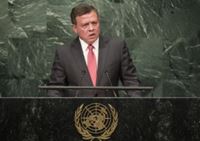
King Abdullah II of Jordan at the United Nations,
September 20, 2016. Photo: Drew Angerer / AFP


INSS Insight No. 859, September 27, 2016


On September 20, 2016, Jordan held elections for its eighteenth parliament. That same day, King Abdullah II delivered his address at the United Nations General Assembly, praising his people for actively participating in the democratic process. By absenting himself from Jordan on election day, the king bowed to an international schedule he had no ability to change. Doing so, however, also signaled his confidence that the Jordanian voters would not opt for any major surprises liable to upset the balance of power between the monarchy and the executive and legislative bodies. During the parliament’s new term, Jordan will continue to face significant challenges, including the war on terrorism; the Salafi jihadist threat; the Syrian refugees, and relations with Israel. The previous Jordanian parliament was not a key player in Jordan’s political, economic, or social theaters. However, a new parliament will soon take office under new regional circumstances, and may have to take serious decisions with long term implications. Perhaps the status of the parliament will then change in the eyes of the 60 percent of the Jordanian electorate that in 2016 stayed home, indifferent to the election and its consequences.

On September 20, 2016, Jordan held elections for its eighteenth parliament. That same day, King Abdullah II delivered his address at the United Nations General Assembly, praising his people for actively participating in the democratic process. Given the blood-soaked civil wars in neighboring Iraq and Syria and the freeze on both the internal process in Lebanon and the Israeli-Palestinian political process, the king has every right to be proud of his nation holding elections. They were transparent for the most part, supervised by more than one hundred European Union and other observers. Although one district required a second round of voting, Jordan emerged from the election as an island of stability in a seething Middle Eastern sea, a nation successfully overcoming internal difficulties that have worsened because of the humanitarian and political chaos plaguing the region.


By absenting himself from Jordan on election day, the king bowed to an international schedule he had no ability to change. Doing so, however, also signaled his confidence that the Jordanian voters would not opt for any major surprises liable to upset the balance of power between the monarchy and the executive and legislative bodies. This balance underwent a minor change in Jordan’s constitution in 2012 as a result of the Arab Spring; accordingly, the king retains his authority and control of the national agenda. While the outgoing parliament was louder and more confrontational on some issues such as Israeli-Jordanian relations than its predecessors, its actual influence on this and other issues was marginal.

The Muslim Brotherhood, or more precisely the Islamic Action Front, the political party representing the Brotherhood in Jordan, commanded much attention. In 2010 and 2013, the party boycotted the entire electoral process, largely because of the advice it received from the Muslim Brotherhood in Egypt. Since then, the movement in Jordan has experienced a change in leadership and an ideological softening, both of which led to a shift in its position on the election. The movement ran candidates in many electoral regions, especially in the capital, where candidates joined forces with others under an umbrella group called the National Coalition for Reform. Thus, candidates ran in the electoral regions of Zarka, Jarash, and the Palestinian refugee camps; returns showed their very partial and limited success. Before the election, one of the Muslim Brotherhood heads in Jordan predicted that the bloc would win 15-20 seats in parliament, especially from voters in Amman (i.e., 10-15 percent of the population). After the results were released, speakers for the movement did in fact boast that they had won 15 seats, but one-third of them were guaranteed by law to women, Christians, and the Circassian community, the other coalition partners. Given the outcome, it would be more accurate to say that in Amman, the refugee camps, Zarka, and Irbid, there is support for the Muslim Brotherhood, but if one takes into account the low voting rates and assumes they equally affected all political parties, one can say with a degree of certainty that in Jordan, the Brotherhood is not a decisive political power.

Apparently the Muslim Brotherhood has managed to recover only partially both from the strategic decision it made in 2010 and 2013 to boycott the election, and from the ramifications of its ties to the Egyptian movement toppled after only a year in power and now hounded by the current Egyptian regime. Another reason for the modest success of the Muslim Brotherhood may lie in the loathing and fear of the Islamic State on the part of most of the older Jordanian voters (although hundreds of Jordanians have joined the ranks of the Islamic State), which grew stronger following the January 2015 brutal murder of Jordanian pilot Muath al-Kasasbeh, held captive in the part of Syria controlled by the Islamic State. Furthermore, the internal split in the movement has weakened it. Two movements – the Association of the Muslim Brotherhood, recognized by the Jordanian government, and the Zamzam Initiative – broke off and ran independently in this parliamentary election. 

Yet an election is not the only measure of the influence wielded by the Muslim Brotherhood’s ideology or of the popularity of the Islamic State. High unemployment among the young, especially the university educated, creates fertile ground for movements with an Islamic orientation. The Jordanian government, with US encouragement, is trying to control – with only partial success – the influence of pirate, unrecognized, and unapproved mosques. Echoes of the regime’s rising concerns could be heard in the king’s address to the UN General Assembly, dedicated mainly to Islam and the perverse image the Islamic State and similar organizations project for it. In this sense, the changes that the Jordanian Muslim Brotherhood made to its leadership, its relations with the Egyptian mother group, and its attitude toward Jordan’s internal political system, could serve as a bridge toward dialogue with the Jordanian sovereign.

Despite important and positive changes instituted since 2012, the Jordanian parliamentary election system still gives numerical preference to candidates running on slates with a local character compared to those running on national lists. In all, 226 lists were approved by the Independent Election Council. Only a minority ran in more than one population center, a fact indicative of separatism and a focus on local issues. It would seem that the composition of a parliament with a local orientation would make it easier for the government to resist parliamentary pressures and serve the regime, which would not have to confront strong parliamentary blocs with a national agenda. On the one hand, the combination of the constitution and the election law has made it relatively easy for the Hashemite regime to weather the years since the Arab Spring with some measure of peace and quiet. On the other hand, the public discourse about the precise function of the parliament and its role vis-à-vis the executive – beyond the formal definition in the constitution – is quite vibrant. At this stage, the regime has passed the hurdles posed by the social and political awakening of the Arab Spring with success, but it must remain attentive to the public mood reflected in the public discourse.

During the parliament’s new term, Jordan will continue to face significant existential challenges. Some of them may have legal significance, such as: the war on terrorism; the enlistment by Jordanian citizens in Salafist jihadist organizations; their involvement in terrorism across Jordan’s borders; and the status of the Syrian refugees in Jordan and their civil and economic rights. These questions will arise with greater urgency than before, and could come to rest at the parliament’s doorstep. The test of this parliament will be its ability to answer them with the requisite degree of national responsibility.

Furthermore, the question of the parliament’s involvement in foreign affairs, in particular Jordanian-Israeli relations, can be expected to resurface. Since the peace treaty between Israel and Jordan, the Jordanian parliament has served as a forum for lambasting Israel, opposing processes of normalization, and criticizing the Jordanian government for not severing the bilateral relations. The return to the parliament provides the Muslim Brotherhood with a ready-made platform to attack the government along the lines of an issue shared with many partners in other political parties. At the same time, the political alliance between the Christian and Circassian communities in Jordan and the Muslim Brotherhood, in its new and less rough-edged form, creates interesting possibilities from Israel’s perspective, as Israel has a parallel communities maintaining widespread connections with their brethren in Jordan.


Finally, the previous Jordanian parliament was not a key player in Jordan’s political, economic, or social theaters. However, a new parliament will soon take office under new regional circumstances, and it may have to take some serious decisions with long term implications. Perhaps the status of the parliament will then change in the eyes of the 60 percent of the Jordanian electorate that in 2016 stayed at home, indifferent to the election and its consequences.


Saturday, August 27, 2016

Fiction TV showing Turkey?


A video from Turkish state TV showing Turkey backed jihadists and Turkish special operation team entering Jarablus. The Bollywood show is doing all fine, the only problem is that the "enemy" seems to be nowhere to found.

Sunday, August 14, 2016

Kurdish-led SDF liberated the city from the darkness of ISIS.


YPJ/YPG & SDF forces celebrate the liberation of Minbic and the victory over the enemy of humanity, Turkey's backed ISIS terrorists in Minbic (Manbij), Rojava. 


Today was an unforgettable day in Manbij after the Kurdish-led SDF liberated the city from the darkness of ISIS. 


Thursday, August 4, 2016

Leaked ‘Heat Map’ shows Bangladesh as growing IS hub.


The map shows IS' worldwide expansion as of August 2016.National Counterterrorism Cente


Bangladesh has witnessed attacks by militants claiming to have pledged allegiance to IS in recent months
A recent classified document of the United States State Department shows Bangladesh as a growing hub of the Islamic State, NBC has reported.
A counterterrorism ‘Heat Map,’ as it is called, shows six countries as ‘aspiring branches’ of IS which includes Bangladesh besides Egypt, Indonesia, Mali, the Philippines and Somalia.
Obtained by the NBC, the heat map also indicates a sharp rise in IS presence across the world since 2014 when State Department documents indicated IS operations in seven countries.
The heat map is part of a classified briefing document for the White House dated “August 2016” and prepared by the National Counterterrorism Center. It shows IS operations in 18 countries.
Bangladesh has witnessed attacks by Islamist militants claiming to have pledged allegiance to IS in recent times. A terrorist attack at a Gulshan restaurant saw 20 hostages executed and two policemen killed. The 12-hour standoff ended with a commando operation on July 2.
Pictures of the five terrorists smiling with their semiautomatic weapons clad in black and sporting red chequered keffiyehs were released by IS as well as pictures of mangled bodies from Holey Artisan, the Gulshan restaurant several hours before the commando operation took place.
A few days later on July 7, the day of Eid ul Fitr, two more policemen and a woman were killed by terrorists near the largest Eid congregation of Bangladesh.
Last week special police units busted a suspected militant den in Dhaka. Released pictures showed the signature black IS flag with Arabic inscription.
However, the authorities have insisted there is no IS presence in Bangladesh and that the terrorists are ‘homegrown’ linked with such outfits as the banned Jamaatul Mujahideen Bangladesh.


Wednesday, August 3, 2016

PM Netanyahu: "This video shook me to the core of my being."


PM Netanyahu: "This video shook me to the core of my being."
I've just watched a video that shook me to the core of my being. In just a few seconds, it shows why our conflict persists.
So here is a short snippet:
"Shoot him! Shoot him! Here he is. Go, go. Shoot him!"
A Palestinian father holds up his 4-year-old son. He pleads with Israeli border police to kill his own child. He shouts, "Shoot this little boy!" His boy.
He pushes his young son forward toward the soldiers and screams, "Kill him! Shoot him!"
The boy pauses. He is scared. Any child would be.
He turns back, looking at his father for guidance.
With his shirt tightly tucked into his bright red shorts, the boy ambles forward towards the soldiers. One of them extends his hand in friendship. The boy gives him a high-five.
It's hard to make a four-year-old hate.
Imagine your own child at that age. Think of his smile. Imagine her laugh. Picture the unrestrained joy and innocence that only a child possesses.
Encouraging someone to murder a child – let alone your own child – is probably the most inhumane thing a person can do.
What did this child do to deserve this? The answer is: nothing. He is innocent.
He should be in a playground. He should be in the sun, laughing with other children.
Sadly, this father's crime is not an isolated example. In Gaza, Hamas runs summer camps that teach children to value death over life – suicide kindergarten camps.
The Palestinian Ministry of Education in Ramallah recently organized an event for students to honor terrorists who murdered three civilians.
Two weeks ago, the Palestinian Authority's official newspaper praised teenage terrorists and wrote that "death as a martyr is the path to excellence and greatness." That's a direct quote.
Palestinian and Israeli children deserve better. They deserve to live. They deserve to live in peace.
Children are not cannon fodder. They are the most precious things in the world. They're the most precious things we have.
I'm sure Palestinian parents, many of them, are as outraged as I am at this video.
And today I appeal to every father and mother around the world. I ask you to join me in calling for an end to this abuse of children.
The Palestinian leadership must stop encouraging children to kill. They must stop encouraging Palestinian parents to call for the death of their own children.
It's horrendous!
Peace begins with respect. If parents don't respect their own children's lives, how will they respect the lives of their neighbors?
We must love all children. They should never be pushed to violence or hate.
Join me in educating all children for peace.


Il Primo Ministro Benjamin Netanyahu interviene sul video, circolato in questi giorni, che riprende un padre palestinese mentre spinge il figlio di 4 anni verso i soldati di frontiera israeliani e urla loro di sparargli:
"Ho appena visto un video che mi ha scosso nel profondo del mio essere; in pochi secondi, mostra il motivo per cui il nostro conflitto persiste. Qui, un breve frammento: 'Sparagli! Sparagli! Eccolo. Vai, vai. Sparategli!'
Un padre palestinese porta suo figlio di 4 anni di fronte ad una pattuglia della polizia di frontiera israeliana e urla ai militari di uccidere il piccolo. Grida: "Sparate a questo bambino!" Il suo bambino. Spinge il figlio in avanti verso i soldati e urla, 'Uccidetelo! Sparategli!'. Il piccolo si ferma; ha paura. Ogni bambino in quella situazione ne avrebbe. Si volta nuovamente e guarda il padre per cercare una guida e capire cosa deve fare. Con la camicia infilata nei pantaloncini di color rosso vivo, il bambino si incammina verso i soldati. Uno di loro gli tende la mano in amicizia. Il piccolo ricambia 'dandogli il cinque'. E' difficile costringere un bambino di 4 anni ad odiare.
Immaginate vostro figlio a quell'età. Pensate al suo sorriso; alla sua risata. Immaginate la gioia sfrenata e l'innocenza che solo un bambino possiede. Incoraggiare qualcuno a uccidere un bambino - per non parlare del proprio figlio - è probabilmente la cosa più inumana che una persona possa fare. Che cosa ha fatto questo bambino per meritare questo? La risposta è: nulla. Lui è innocente. Questo bambino dovrebbe essere in un parco giochi, stare sotto il sole, ridere con gli altri bambini.
Purtroppo, il gesto criminale di questo padre non è un esempio isolato. A Gaza, Hamas gestisce campi estivi che insegnano ai bambini ad apprezzare e a dar valore alla morte invece che alla vita – una sorta di asili o campi estivi per il suicidio. Il Ministero della Pubblica Istruzione palestinese a Ramallah ha recentemente organizzato un evento per studenti in onore dei terroristi che hanno ucciso tre civili. Due settimane fa, il giornale ufficiale dell'Autorità Palestinese ha elogiato terroristi adolescenti e ha scritto che "la morte da martire è il percorso verso l'eccellenza e la grandezza." Testuali parole.
Bambini palestinesi e israeliani meritano di meglio. Essi meritano di vivere; meritano di vivere in pace. I bambini non sono carne da cannone. Sono le cose più preziose al mondo. Sono le cose più preziose che abbiamo. Sono sicuro che molti genitori palestinesi siano indignati quanto me di fronte a questo video.
E oggi mi appello a tutti i genitori in tutto il mondo. Vi chiedo di unirvi a me nel chiedere la fine di questo abuso di innocenti. La leadership palestinese deve smettere di incoraggiare i bambini ad uccidere. Devono smettere di incoraggiare i genitori palestinesi a chiedere la morte dei propri figli. E' orrendo! La pace inizia con il rispetto. Se i genitori non rispettano la vita dei loro bambini, come faranno a rispettare la vita dei loro vicini? Tutti dobbiamo amare i bambini. Essi non dovrebbero mai essere spinti verso la violenza o l'odio. Unitevi a me per educare tutti i bambini alla pace."